 ExotElectronics
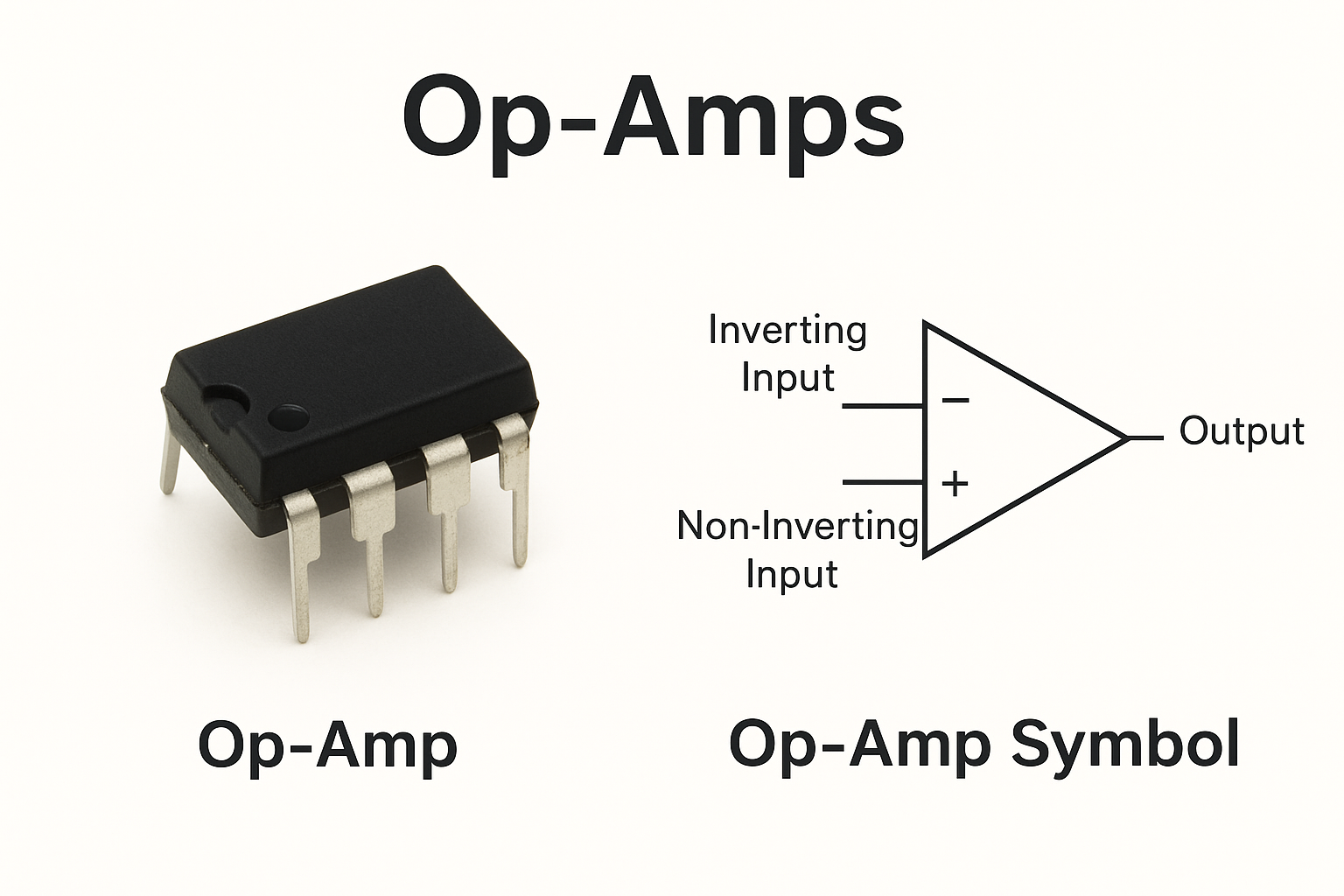
Common Applications of Operational Amplifiers (Op-Amps)
Operational amplifiers (op-amps) are extremely versatile analog integrated circuits. Because of their high gain, high input impedance, and low output impedance, op-amps are used in a wide variety of electronic circuits ranging from audio systems to industrial instrumentation.
1. Voltage Amplifier (Signal Amplification)
One of the most common uses of an op-amp is to amplify small voltage signals. In this configuration, the op-amp increases the amplitude of an input signal without significantly altering its shape.
A typical example is an audio preamplifier, where weak signals from microphones, guitars, or sensors are amplified to levels suitable for power amplifiers or audio processors.
The amount of amplification (gain) is determined by external resistors connected to the op-amp. This allows designers to precisely control how much the signal is amplified.
Typical uses: audio preamps, sensor signal conditioning, medical instrumentation.
Read full explanation Inverting Amplifier
Read full explanation Non Inverting Amplifier
2. Voltage Follower (Buffer Amplifier)
A voltage follower is an op-amp configuration where the output is directly connected to the inverting input. In this case, the voltage gain is exactly 1.
Although it does not amplify voltage, this circuit is extremely important because it isolates one part of a circuit from another. The op-amp presents a very high input impedance to the source and a very low output impedance to the load.
This prevents signal loss and distortion when a weak signal source must drive a heavier load.
Typical uses: buffering sensor outputs, audio signal isolation, impedance matching.
3. Summing Amplifier (Audio Mixer)
A summing amplifier uses an op-amp to combine multiple input signals into a single output. Each input is applied through a resistor, and the op-amp adds them together.
This configuration is widely used in audio mixers, where signals from microphones, instruments, or media players are mixed into one audio channel.
By choosing different resistor values, each input can be given more or less weight, allowing volume control for individual channels.
Typical uses: audio mixing consoles, signal combination in control systems, analog computing.
4. Differential Amplifier
A differential amplifier amplifies the difference between two input voltages while rejecting any voltage that is common to both inputs.
This property is extremely valuable in noisy environments, where interference may be picked up equally by both signal lines. The op-amp effectively cancels out this common noise.
Differential amplifiers are the foundation of instrumentation amplifiers, which are used for precise measurement of small signals.
Typical uses: strain gauges, biomedical sensors (ECG, EEG), industrial measurement systems.
5. Comparator
When used as a comparator, an op-amp compares two voltages and produces a digital-like output indicating which voltage is higher.
If the voltage at the non-inverting input is higher than the inverting input, the output saturates toward the positive supply. If it is lower, the output goes toward the negative supply.
Although dedicated comparator ICs are often preferred, op-amps are still commonly used for simple comparison tasks.
Typical uses: zero-crossing detectors, over-voltage protection, level detection circuits.
6. Integrator
An integrator uses an op-amp with a capacitor in the feedback path. The output voltage is proportional to the integral of the input signal over time.
This means the output accumulates the input signal, producing waveforms such as ramps or slow-changing voltages.
Integrators are widely used in analog signal processing and control systems.
Typical uses: waveform generation, analog computers, PID controllers.
7. Differentiator
A differentiator produces an output proportional to the rate of change of the input signal. Rapid changes result in higher output voltages.
This makes differentiators useful for detecting edges, spikes, or sudden transitions in signals.
Practical differentiators include additional components to reduce noise sensitivity.
Typical uses: edge detection, motion sensing, signal conditioning.
8. Active Filters
Op-amps are widely used to build active filters such as low-pass, high-pass, band-pass, and notch filters.
Unlike passive filters, active filters can provide gain and do not require inductors, making them compact and efficient.
These filters are essential in audio systems, communication circuits, and data acquisition systems.
Typical uses: audio equalizers, noise reduction, signal conditioning.
9. Oscillator
Op-amps can be configured to generate oscillating waveforms such as sine, square, or triangle waves without any external input signal.
The oscillation frequency is determined by resistors and capacitors connected around the op-amp.
Typical uses: signal generators, clock sources, audio tone generators.
10. Precision Rectifier
A precision rectifier uses an op-amp combined with diodes to rectify very small AC signals that ordinary diodes cannot handle accurately.
The op-amp compensates for the diode voltage drop, allowing accurate rectification even at millivolt levels.
Typical uses: AC voltmeters, signal detectors, audio envelope followers.
In summary, operational amplifiers are fundamental building blocks in analog electronics. Their flexibility allows engineers to design amplifiers, filters, signal processors, and control systems using a single type of component.